Wrestling with War: The Crusades
Isabella Terranova
5/26/2026
Humanity is no stranger to the destruction and devastation of war. War is often waged for contemptible reasons, born from man’s fallen nature. God created every human being in his image, endowing them with inherent worth. The senseless loss of life is grievous in his eyes. God takes, “no pleasure in the death of anyone” (Ezekiel 18:32). Jesus also preached a remarkably nonviolent message, instructing us not to “resist an evil person” (Matthew 5:39). It is important to note, however, that there are times when God has condoned war. In Deuteronomy, God commanded the Jews to destroy various lands: “When the Lord your God brings you into the land that you are about to enter and occupy and he clears away many nations before you…then you must utterly destroy them” (Deuteronomy 7:1-2). How do we reconcile God’s radically pacifist commands with his endorsement of war in the Bible? Does God call us to strictly avoid violence, or is war sometimes a necessary evil?
God is not against the use of force when it is justified. This is clear from the fact that He used war to bring divine justice upon humanity. Similar to the flood, God’s instruction for the Israelites to wage war was intended to remove wickedness from the Earth. Those who were eliminated were committing sins so egregious that the land had “become defiled” (Leviticus 18:27). God is infinitely just, and so are his decrees to wage war, but most people today are not hearing God’s audible voice telling them to engage in battle. Is war ever justified absent God’s audible command?
To discern if humanity can righteously wage war without God’s expressed support, it is important to analyze what the Bible says about violence. Jesus was certainly a pacifist in the sense of repudiating the use of violence for personal gain or revenge. This is reflected in the Sermon on the Mount, when Jesus says, “if someone slaps you on the cheek, give them the other cheek as well” (Matthew 5:39). Being slapped on the cheek was seen less as a physical attack, but instead as an attack on one’s honor and dignity. Jesus abhors pride, which is why He tells us to put our egos aside and submit to minor threats. The goal is repentance and reconciliation.
Though defending one’s honor is an unjustified use of the sword, the Bible suggests that the use of violence to defend one’s life can be justified. In the Gospel of Luke, Jesus instructed his apostles to equip themselves with swords in exchange for their cloaks: “And let the one who has no sword sell his cloak and buy one” (Luke 22:36). By instructing the apostles to arm themselves, Jesus acknowledged the necessity of personal protection. This disproves the claim that Jesus was a pacifist. He did not, however, condone violence motivated by anger. In the Garden of Gethsemane, on the night of Jesus’ betrayal, the apostle Peter, in an attempt to prevent Jesus from being arrested, zealously drew his sword and cut off the ear of the high priest’s servant (Matthew 26:51). Jesus was quick to reprimand him: “Put your sword back into its place. For all who take the sword will perish by the sword” (Matthew 26:52). Because Peter used it in such an impulsive and aggressive manner, versus as a means of defense, Jesus voices disapproval for his eagerness to use the sword, not for use of the sword universally. Using violence out of anger is wrong, and Jesus’ statement reveals that careful discernment is required to determine when to take aggressive measures.
It appears that the use of violence in defense is biblically justified, although it is very important to determine what is being defended. The defense of pride or property does not warrant lethal force. Exodus 22:2-3 states: “If a thief is caught breaking in at night and is struck a fatal blow, the defender is not guilty of bloodshed; but if it happens after sunrise, the defender is guilty of bloodshed.” Since a thief caught breaking in during the daylight should not be physically harmed, killing in the name of defending property is unjustified, and constitutes a form of vengeance. This claim is further supported by the Sermon on the Mount, where Jesus says, “if someone takes your shirt, give them your cloak as well” (Matthew 5:40). However, in the uncertainty of the darkness, potentially killing an intruder is not considered murder by God, who understands the adrenaline-inducing atmosphere of encountering a threat during the night. This distinguishes the difference between using violence to defend property, and using violence to defend innocent life; the former is unjustified retaliation, whereas the latter is legitimate defense.
Violence being warranted to protect the innocent and Jesus’ death on the cross appear to be contradictory. After all, Jesus lived a sinless life, and was the most innocent man to ever walk the Earth. His and the other apostles’ deaths on the cross were extreme acts of nonviolence, but the key element is that they willingly submitted to death on the cross. Jesus’ death was a necessary fulfillment of prophecy to atone for human sin and broaden our accessibility to salvation, and the apostles’ deaths were similarly symbolic, as they were martyred in demonstration of their faith. Some may argue that every Christian should therefore submit to violence and persecution, but not all violence Christians face is because they are Christian, or because they refuse to deny the truth. There is an important distinction to be made between senseless violence, and violence to which a Christian’s submission would be an impactful testament to their allegiance to God. As prominent pastor and Christian author Scott Roberts observes, “Some attacks are criminal; others are persecution. The former calls for the protection of life; the latter sometimes calls for patient endurance.” War is never ideal, but when it is the only option to protect the innocent, it may be necessary.
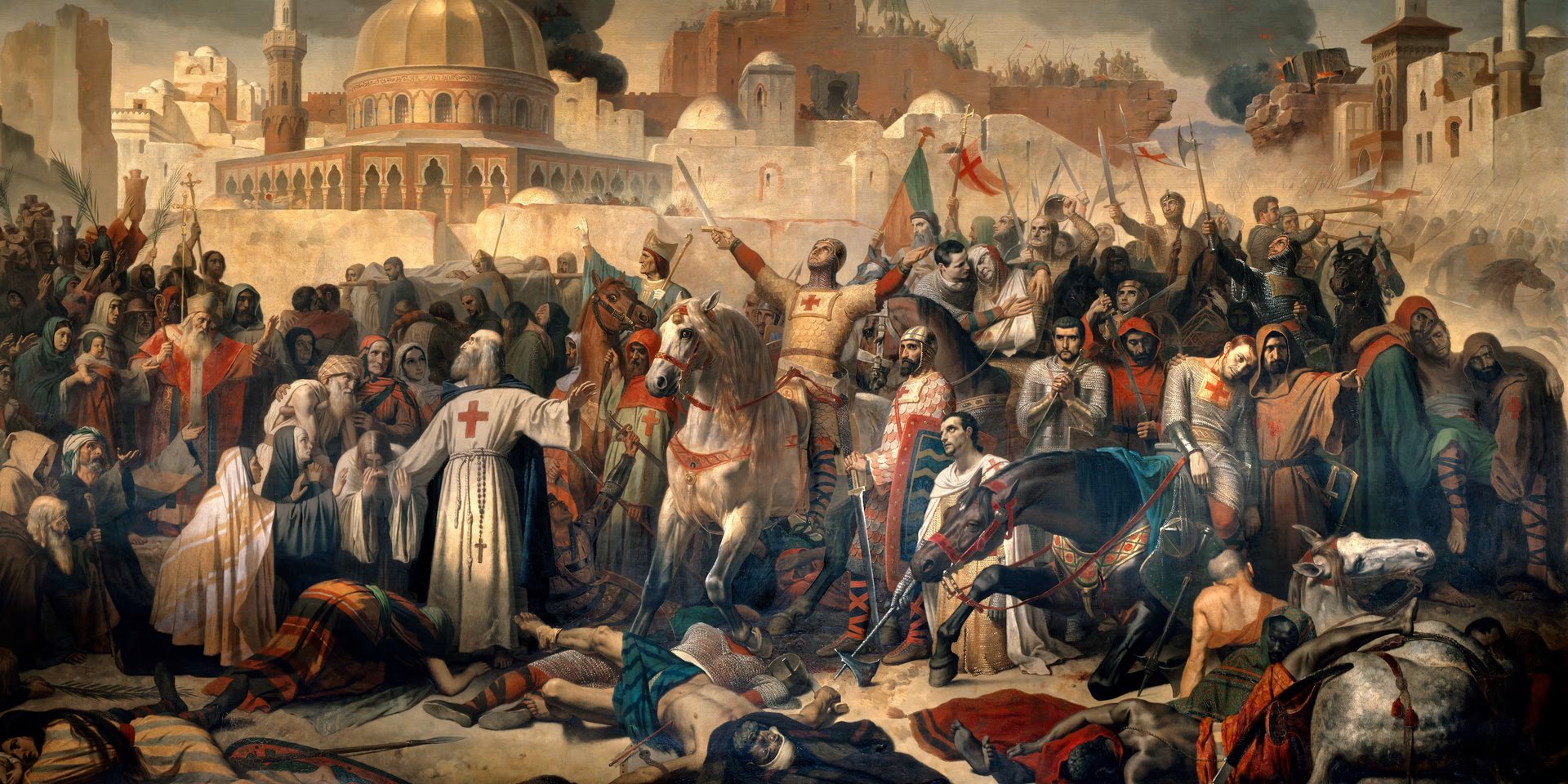
God does not require Christians to remain complacent while the innocent are ruthlessly slaughtered, but Scripture also teaches that violence must be exercised with wisdom rather than anger, vengeance, or the desire to reclaim lost dignity or property. These moral distinctions are especially relevant when examining one of the most famous religious conflicts in Christian history: the Crusades. Fought primarily between western Christendom and the Islamic east between 1095 and 1291 AD, the Crusades are often viewed by modern Christians as a stain on the church’s history and condemned as cruel expansionism akin to colonial conquest. However, the historical reality of the Crusades is far more nuanced, and demands careful Biblical analysis to determine whether these wars were acts of unjust aggression, a legitimate defense of the innocent, or somewhere in between.
Whether or not the Crusades are Biblically defensible depends on the nature of Islamic expansion. The father of Islam, Muhammad, would live to experience what he believed were revelations which inform the faith. As Muhammad grew in status as a spiritual and political leader, he became significantly less tolerant of criticism and oversaw the slaughter of many who verbally opposed him or who left Islam. After the death of Muhammad, various Arab tribes utilized the opportunity to renounce Islam, prompting the Ridda Wars in which up to 40,000 apostates were killed for threatening Islam’s dominance in these conflicts. These accounts dispute the narrative that Muhammad only engaged in purely defensive battles and that Islam expanded peacefully.
Prior to the First Crusade, traditionally Christian lands were conquered and ravaged by Islamic forces for over 400 years. Violent conquests continued after Muhammad’s death, and by the end of the 11th century, well over half of Christendom had been taken captive by Islam. These regions included, but were not limited to, prominent provinces such as Egypt, Syria, Spain, Portugal, Sicily, and Jerusalem. Many ancient sources document the violent and bloody nature of Muslim conquest. One ancient primary source describes the Muslim invasion of Damascus, Syria: “Romans fled from the vicinity of Damascus {and there were killed} many {people}, some ten thousand….In the year [636] there gathered in Gabitha {a multitude of} the Romans, and many people {of the Romans were killed}, some fifty thousand.”
Despite the terror Muslim violence inspired, Christians peacefully resisted at times, namely in Spain. In 850, the Catholic priest Perfectus was arrested and executed in Cordoba for denouncing Muhammad, prompting many Christians to peacefully protest and resulting in many more executions between 850 and 852. Christians, despite facing threats of massacre in 855, urged Muslims to convert to Christianity in Cordoba’s public square. Nonviolence yielded minimal results; many were killed, raped, or sold into slavery. These incidents were not isolated - they characterize the Islamic conquest of Christian lands from 613 to 1095 AD. Especially considering unfruitful attempts at nonviolence, Muslim aggression certainly warranted defensive wars waged against the invaders.
When the Seljuk Turks invaded the Byzantine Empire in 1095, this marked the official catalyst of the First Crusade. Following the bloody invasion, the Byzantine Emperor called for aid from Pope Urban II of the Catholic west. Pope Urban II gave a rousing speech, uniting much of Christendom in the effort: “For your brethren who live in the east are in urgent need of your help…as the most of you have heard, the Turks and Arabs have attacked them and have conquered the territory…They have killed and captured many, and have destroyed the churches and devastated the empire. If you permit them to continue…the faithful of God will be much more widely attacked by them.” Though some who answered to the call were apathetic to the cause and simply sought war loot, most crusaders were commoners and peasants who felt the need to protect their Christian brethren.
Of course, protecting the innocent was not the entire aim of the Crusades. A primary motivator of every crusade was reclaiming the lands which had once been Christian, and were now under Muslim occupation. The First Crusade’s expressed intent was to recover Jerusalem, namely because of the Holy Sepulchre, which was considered the holiest of sites and the destination of many pilgrimages. This introduces a moral tension, as Scripture warns against vengeance and the reclamation of stolen property through violence: "Give to everyone who asks you, and if anyone takes what belongs to you, do not demand it back" (Luke 6:30). However, the desire to reclaim lost territories can overlap with the aim to protect the innocent who lived under belligerent rulers, had it not been for the interest in lost objects and relics. The Holy Sepulchre, for instance, had immense religious significance, serving as the location where Jesus was buried and home of the cross on which he was crucified. There is some merit to the claim that Christians who journeyed to the Holy Sepulchre were in danger due to Muslim aggressors, but the desire to reclaim lost territory and relics because of their cultural significance extends the Crusades’ motives beyond the protection of innocent lives. The desire to redeem the church’s symbolic legacy renders the Crusades less justifiable, as the only biblically legitimate basis for retaking lost lands is to protect the innocent. Additionally, Pope Urban II encouraged men to fight in the Crusades by telling them that the war would cleanse them of their sins, which is a biblically unfounded claim, and raises further theological concerns.
Christians were no doubt subjected to persecution preceding the Crusades, but as evidenced by Jesus himself, persecution does not always warrant violence. However, the criminal murder of thousands of Christians at the hands of Islamic conquerors could hardly be ignored by European forces, and wars fought in self-defense prior to the Crusades were undoubtedly justified. The Crusades themselves were a series of many different battles, the true motives of which raged from material gain, regaining lost territory, and the protection of innocent life. Unfortunately, there were a significant number of Crusaders who strayed from the aim to preserve life and who used unwarranted brutality against Christians, Jews, and Muslims alike. These wars were far from perfectly justified in practice. However, the besiegement of the Byzantine Empire and the Seljuk Turks’ disembowelment and boiling of their captives prior to the First Crusade rightly provoked the need for a defensive war. Many of the Crusaders were aware of these brutalities, and were prompted to join the fight because of righteous conviction. Though the Crusades were partly motivated by the desire to reclaim lost property as well as to protect innocent lives, recovering stolen territories may have been seen as a byproduct of the goal to protect the innocent for some. What can be said for certain is that those who joined the Crusades to help defend the innocent from violence were justified in principle, for Scripture affirms the moral obligation to protect life when no other options remain.
Sources
“The Arab-Islamic Conquest and Its Devastating Impact on the Mediterranean Countries and the East.” (n.d.). Phoenicia.org. Phoenicia.org
“Christian Martyrs in Muslim Spain.” (n.d.). Documenta Catholica Omnia. Translated by Kenneth Baxter Wolf. Documenta Catholica Omnia
“The Crusades.” (n.d.). Church in History Information Centre. Church in History Information Centre
“Historical Muhammad: The Good, the Bad, and the Downright Ugly.” (n.d.). North American Mission Board. North American Mission Board
“Pope Urban II Orders First Crusade.” (n.d.). History.com. A&E Television Networks. History.com
“Riddah.” (n.d.). Encyclopaedia Britannica. Britannica
Roberts, S. (n.d.). What should Christians think about self-defense and war? Scott Roberts Official Website
“The Crusades: Justification Arguments.” (n.d.). Theology on the Edge Student Organization at Ohio State University. Theology on the Edge Student Organization at Ohio State University
“The Systemic Elimination of Critics in Islam.” (n.d.). RRI Media. RRI Media
Urban II. (1095). Speech at Clermont. The Latin Library. The Latin Library
“The Holy Sepulchre.” (n.d.). Encyclopaedia Britannica. Britannica Holy Sepulchre Entry
Want to Join the Team?
The Prayerful Perspectives Journal is always looking for writers! If you're a Christian with a passion for law, politics, and the realm of philosophical debate, we'd be delighted to have you. Submit an application if interested.